Walk the 1500 block of South Pearl on a Wednesday night and you will pass a building with no sign. No awning, no name stenciled on the glass, nothing that tells you two of Colorado's six Michelin-starred restaurants are running full service behind that door. You have to already know. That is not an accident, and it is not really about restaurant marketing either. It is the clearest evidence of something true about this whole street that most of the recent coverage has missed: the fanciest thing to happen to South Pearl in years did not arrive from outside. It grew out of the same six blocks that have been doing this for forty years.
The Building Toshi Kizaki Built Himself
Start with the chef. Toshi Kizaki came to South Pearl Street with his brother Yasu nearly forty years ago, when the block still had a gas station, an auto repair shop, and a for-rent sign on a former Piggly Wiggly grocery store. That empty grocery store became Sushi Den in 1984, and Sushi Den has been the anchor of Japanese food in Denver ever since.
What most residents may not have clocked yet is what Kizaki did with the rest of his career. He opened Izakaya Den and Ototo up the block. Then, at seventy years old, he designed and built his own building at 1551 South Pearl Street and put a nine-seat chef's counter behind a dim, stone-lined hallway with no street signage at all. He called it Kizaki. It opened in spring 2025, one block from where he started forty years earlier, and within months the Michelin Guide gave it a star, making him the oldest sushi chef in the country to earn one for the first time. The dining room seats forty people across four nights a week. That is the whole business model: not volume, attention.
Justin Fulton's restaurant Margot occupies the rest of that same building. Fulton had spent three years popping up in other people's kitchens around the city before Kizaki, looking for someone to fill the remaining space, brought him in. Margot opened in early summer 2025 and picked up its own star in the same Michelin cycle that recognized Kizaki, making South Pearl the only stretch of the district with two starred kitchens sharing a single address.
"There's been a nice, steady evolution and growth of the area, and it just seems to get better and better," said Mark Gill, president of the South Pearl Street Association, describing the resurgence to the Denver Gazette last fall.
The word doing the real work in that quote is evolution, not arrival. Nobody bought this block and reinvented it. The same chef who opened here in 1984 is the same chef who just built the room he always meant to build, forty years later, on the same street.
The Same Kitchen, a Different Entry Point
If the tasting menu at Kizaki or Margot sounds like an occasion rather than a Tuesday, that is by design, and it is also not the whole story. Margot runs a Sunday brunch that is, as far as anyone covering Denver dining can tell, the only Michelin-starred brunch service in the city. Same kitchen, same team, a menu that does not require the same commitment as the evening tasting menu. The beignets are two dollars.
That detail matters more than it looks like it should. It means the fanciest address on the street is also one of the more approachable ones on a given weekend, if you know to ask for the brunch menu instead of the reservation-months-out tasting counter. Locals who have been putting off Margot because the evening prices felt like a special occasion now have a lower-stakes way in.
The Street That Pays for Its Own Lamps
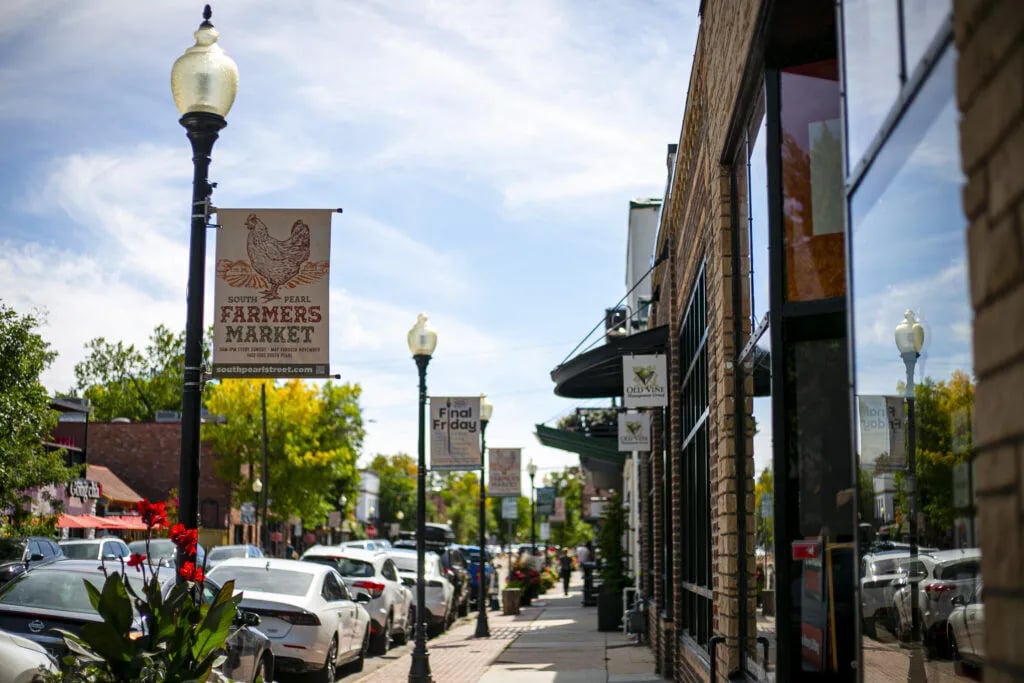
Here is the part of the story that explains why South Pearl still feels like a neighborhood commercial strip and not a corridor being managed from a downtown office somewhere. The South Pearl Street Association, which has existed for more than forty-one years, is not funded by the city of Denver or any other government body. It runs entirely on merchant dues, at fifteen dollars a month per business, and that money is what pays to install, power, maintain, and insure the three street arches and forty street lamps that give the block its look after dark.
That is worth sitting with for a second. Every lamp you walk under on a Sunday farmers market morning or a Friday art walk evening exists because a boutique owner or a restaurant owner down the street decided to keep paying into a shared pot, year after year, decade after decade. The street funds its own infrastructure the same way Kizaki funded his own restaurant: nobody outside came in to do it for them.
What Is Actually Left of This Season
The South Pearl Street Farmers Market runs every Sunday from 9am to 1pm through November 8, which means there are ten Sundays left before the 1400 and 1500 blocks close back down for winter. More than 170 vendors set up along that stretch, and this year's lineup added new names worth flagging if you have not gone recently: Panda Bao, Rang Tang Craft BBQ, Pupusas Familia, and Send Flours Baking Co all joined the roster for 2026, alongside returning regulars like Rebel Bread and Queen City Collective Coffee.
If you time it right, Stella's Coffee Haus sits roughly halfway through the market route, which makes it a natural stopping point if you are hauling produce and need a bathroom break or a place to sit before finishing the loop. It has been on South Pearl since 1991, which is longer than most of the restaurants that get written up now.
The other calendar item worth marking down is Final Friday Art Walk, which runs the last Friday of the month from June through October, 5pm to sundown, on the 1400 to 1600 blocks. Two dates remain this year: September 25 and October 30. It is a smaller, quieter version of a First Friday walk, built around sidewalk demonstrations from working artists and vintage vendors rather than gallery openings, and it tends to draw people who already live within walking distance rather than crowds bussed in from elsewhere.
Between now and Thanksgiving, that gives South Pearl residents two more Art Walk Fridays and ten more market Sundays before the street settles into its quieter winter rhythm.
Why the Continuity Is the Point
None of this reads as a neighborhood in transition. A Michelin-starred chef who has owned property on the block since the Reagan administration. A merchant association old enough to have funded its own streetlights through four decades of dues. A farmers market that has run every May through November since 2001. A brunch that costs two dollars for the same beignet a tasting menu customer pays two hundred and fifty dollars to eat alongside twenty other courses.
The easy version of this story is that South Pearl Street got discovered, the way people talk about a neighborhood suddenly showing up on a list. The truer version, and the one the last year of coverage keeps circling without quite naming, is that the people who built this street in the first place are the same people cashing in on its best year yet. Kizaki did not need outside investment to build his building. The Association did not need a city grant to install its lamps. The market did not need a developer to keep running for twenty-five years straight.
That is a different kind of stability than most commercial strips get to claim, and it is the reason South Pearl still feels like a place you walk to on a Sunday morning rather than a destination you plan a trip around.
If you are already living in Platt Park, none of this changes your Tuesday. But it is worth knowing what is actually happening two blocks from your front door, and why it is holding together the way it is.
Looking at property here, or wondering what a home near this stretch of South Pearl is worth in today's market? Kylie and Jesse Russell know this street block by block. Request Your Home Valuation and get a straight answer grounded in what is actually happening in Platt Park right now.